The Scientist Who Discovered THC: Raphael Mechoulam and the Moment Cannabis Became Science
At the start of the 1960s, science had a strange blind spot. Morphine had long since been isolated from opium. Cocaine had already been taken apart and mapped by chemists in exacting detail. But cannabis, one of the mos…
The Scientist Who Discovered THC: Raphael Mechoulam and the Moment Cannabis Became Science
At the start of the 1960s, science had a strange blind spot. Morphine had long since been isolated from opium. Cocaine had already been taken apart and mapped by chemists in exacting detail. But cannabis, one of the most famous and most argued-over plants on earth, still drifted somewhere between rumor, police evidence, colonial anxiety, and vague medical language. People knew it did something. They did not know the central thing: what exactly in it was doing the work.
Into that gap stepped Raphael Mechoulam. Not a countercultural prophet, not a romantic of smoke, and not an ideologue of legalization. A chemist. A deeply serious, unusually calm, almost stubbornly academic man who simply could not understand how the scientific world had left cannabis in the shadows for so long. What caught his attention was precisely that mismatch: one of the planet's best-known psychoactive plants was still chemically underexplained.
An entire era grew out of that irritation.
Not a man of myth, but a man of precision
Raphael Mechoulam was born in Sofia, Bulgaria, in 1930, survived wartime Europe, and moved to Israel in 1949. Nothing in his biography fits the image of an eccentric researcher chasing scandal. If anything, he moved in the opposite direction: toward discipline, biochemistry, organic chemistry, and the study of natural products. He studied at the Hebrew University, earned his PhD at the Weizmann Institute, completed postdoctoral work at Rockefeller Institute, and then returned to build a scientific program of his own.
That is essential to understanding him. Cannabis did not attract Mechoulam because it was fashionable. It attracted him because it represented an intellectual hole. He later explained the impulse with disarming simplicity: morphine and cocaine had been studied for decades, yet the active constituents of cannabis still had not been isolated in pure form. To a good chemist, that is almost an affront. If a substance changes consciousness, pain, memory, mood, and appetite, yet science cannot identify its main active molecule, then the real problem is not the plant. It is that nobody has asked the question properly.
The moment cannabis entered the laboratory
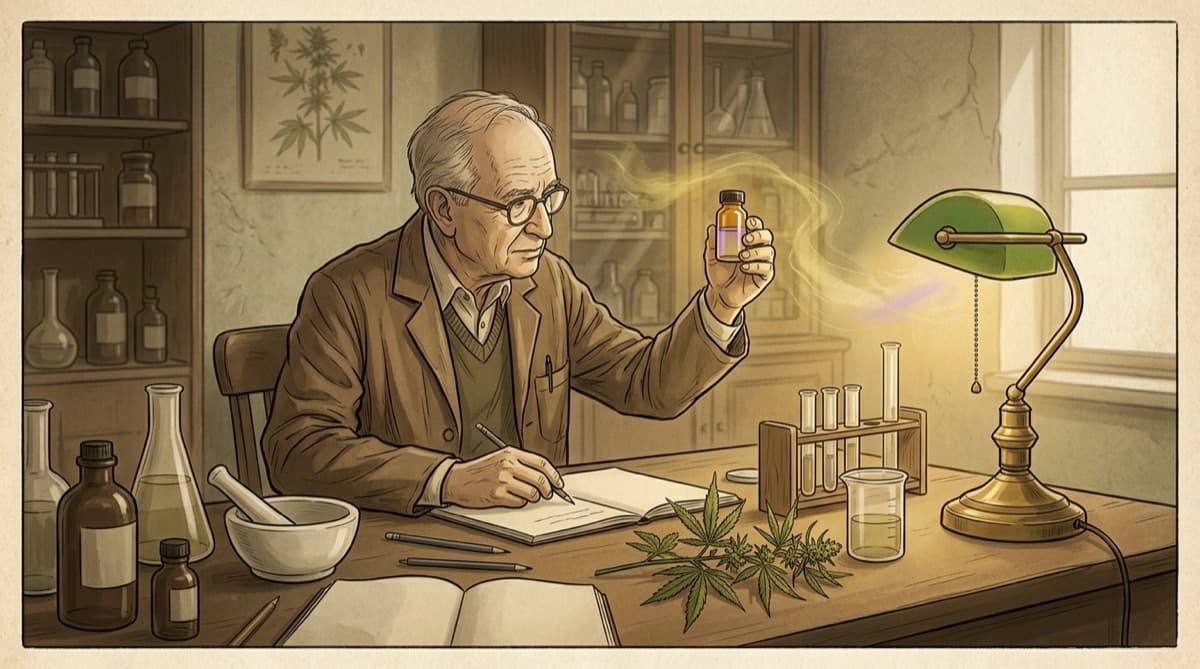
There is one scene that explains almost everything about this story. In the early 1960s, Mechoulam obtained confiscated hashish from the Israeli police for research. By his own recollection, he simply carried it home on a bus, and before long other passengers began looking around: the smell coming from his bag was too distinctive to ignore. Today the anecdote sounds almost comic, but it contains the decisive turn. Before Mechoulam, cannabis was more likely to sit in a police evidence room, on the street, inside newspaper panic, or in half-formed medical speculation. He did something at once simple and revolutionary: he moved it onto the laboratory bench.
That was the real break. Not a slogan. Not a culture war. Not a moral argument. Glassware, purified fractions, analysis, molecular structure.
For the first time, cannabis was being treated not as a blurry social problem, but as an object of strict chemistry.
1964: psychoactivity finally got a name
In 1964, Raphael Mechoulam and Yehiel Gaoni published the paper that isolated and described the structure of delta-9-tetrahydrocannabinol, or THC. This molecule turned out to be the principal psychoactive component of cannabis.
It is hard to overstate what that meant. Before that moment, researchers had extracts, hints, scattered effects, and vague talk about an "active principle." After 1964, science had a molecule. It could be synthesized, compared, dosed, tested, and discussed without mysticism and without linguistic fog.
In other words, Mechoulam did not merely "figure out what gets you high." He gave science the language in which cannabis could be discussed seriously at all.
From that point on, a new phase began. Once the active compound was known, researchers could study not only intoxication or euphoria, but mechanism, toxicology, therapeutic potential, and the way cannabis interacts with brain and body. That is how cannabis began to move out of the realm of legend and into the realm of biochemistry.
Why this was bigger than one discovery
At first glance, the story sounds local: a scientist isolates THC and the world moves on. But discoveries like that cast a long shadow. Once it became clear which molecule was responsible for the main psychoactive effect, the next major question emerged immediately: where, exactly, does it land in the body?
If THC has a specific action, then the body must have a mechanism capable of recognizing that action. Step by step, that line of inquiry led to the discovery of cannabinoid receptors and then to an even more beautiful turn: the human body, it turned out, produces its own compounds that work along related pathways.
In 1992, Mechoulam's group helped identify anandamide, the first endocannabinoid. The name comes from the Sanskrit word ananda, meaning "bliss," but the science behind it was far bigger than the poetry. Cannabis affects us not because it crudely hacks some foreign system, but because it enters an existing physiological circuit. Pain, appetite, memory, emotion, sleep, stress: all of it turned out to be connected to what we now call the endocannabinoid system.
This is where Mechoulam's true place in history becomes clear. He did not only discover THC. He helped uncover the question that changed neuroscience and pharmacology: why does the human body contain a system on which cannabinoids fit so precisely?
Why he cared so deeply about the subject
Mechoulam had the rare ability to keep a cool head where society overheats. For decades, cannabis dragged behind it too much noise: criminalization, exoticism, moral panic, counterculture, ideological battles. Many people either demonized the plant or turned it into a symbol of liberation. Both reactions got in the way of science.
Mechoulam seems to have seen in that confusion not a reason to retreat, but a reason to move closer. His interest was classical in the best scientific sense: if an object is covered in myth, then it needs to be broken down into molecules all the more urgently. If society is shouting, the chemist should measure. If everyone assumes the answer is obvious, the researcher has a duty to test whether anything is actually clear.
That was his temperament. Not cannabis for cannabis's sake, but truth for precision's sake. And it was exactly that posture that made him almost legendary in cannabinoid science. Without people like him, a field does not mature. It remains a pile of arguments, anecdotes, and ideological masks.
Raphael Mechoulam and the birth of cannabis science
Today cannabis is discussed in many registers at once: medical, recreational, regulatory, cultural, botanical, commercial. Yet behind nearly every serious conversation stands Mechoulam's work.
When clinicians talk about the difference between THC and CBD, they are walking along a path he helped clear.
When neuroscientists discuss CB1 receptors, anandamide, and endocannabinoid tone, they are still working inside a field he helped create.
When the medical cannabis sector tries to move from slogans to evidence, it is still operating inside a space opened by the strict chemical questions Mechoulam asked decades ago.
That is why calling him the "father of cannabis research" is not just flattering language. It is almost technically precise. He was the person who took a plant with a cultural biography thousands of years old and asked it the questions of a real chemist. What here is active? How is it built? Why does it work? What in the body answers that signal?
Sometimes questions like those move history more than manifestos do.
Not a hero of smoke, but a hero of clarity
What is especially compelling about Mechoulam is that he made cannabis less foggy without making it less complex. After his work, the plant did not become boring. It became more interesting. What emerged was not a single "drug with an effect," but an entire chemical universe: THC, CBD, minor cannabinoids, receptors, endogenous ligands, enzymes, memory, inflammation, pain, neuroprotection.
He did not simplify cannabis. He replaced myth with knowledge.
At LIBRARY, that is the strongest part of the whole story. Cannabis has long deserved a conversation in which culture, caution, and science can coexist. If you are interested not only in chemistry, but also in the language around the plant, we have a piece on the etymology of cannabis, marijuana, and ganja. And if you want to move from history toward a more practical local context, you can continue with the FAQ and the catalog. In any good conversation about cannabis, sensation is never enough; precise words, verifiable facts, and context matter just as much. Raphael Mechoulam did more than almost anyone in the twentieth century to make that kind of conversation possible.
This material is for informational purposes only and does not replace medical or legal advice. Please follow local law in Thailand.
Quick Answer
Raphael Mechoulam identified THC in 1964 and helped turn cannabis from a cloud of myths into a serious scientific field, later contributing to the discovery of the endocannabinoid system through work on anandamide.
📚Sources & References
- 1Gaoni Y., Mechoulam R. — Isolation, structure and partial synthesis of an active constituent of hashish (JACS, 1964)
- 2Devane WA et al. — Isolation and structure of a brain constituent that binds to the cannabinoid receptor (Science, 1992)
- 3Prof. Raphael Mechoulam | Scientific Council, Weizmann Institute
- 4Tribute to PROF. Raphi Mechoulam | Cannabinoids Research, Hebrew University
- 5Interview: Professor Dr. Raphael Mechoulam