Rastafari and the Holy Herb: How a Jamaican Faith Turned Cannabis Into a Sacrament
A hundred thousand people stood on a Caribbean runway in 1966, drumming, chanting, and smoking so much ganja that the air itself had turned hazy green. The man they believed to be God took one look at the crowd, stepped back inside the plane, and refused to come out.
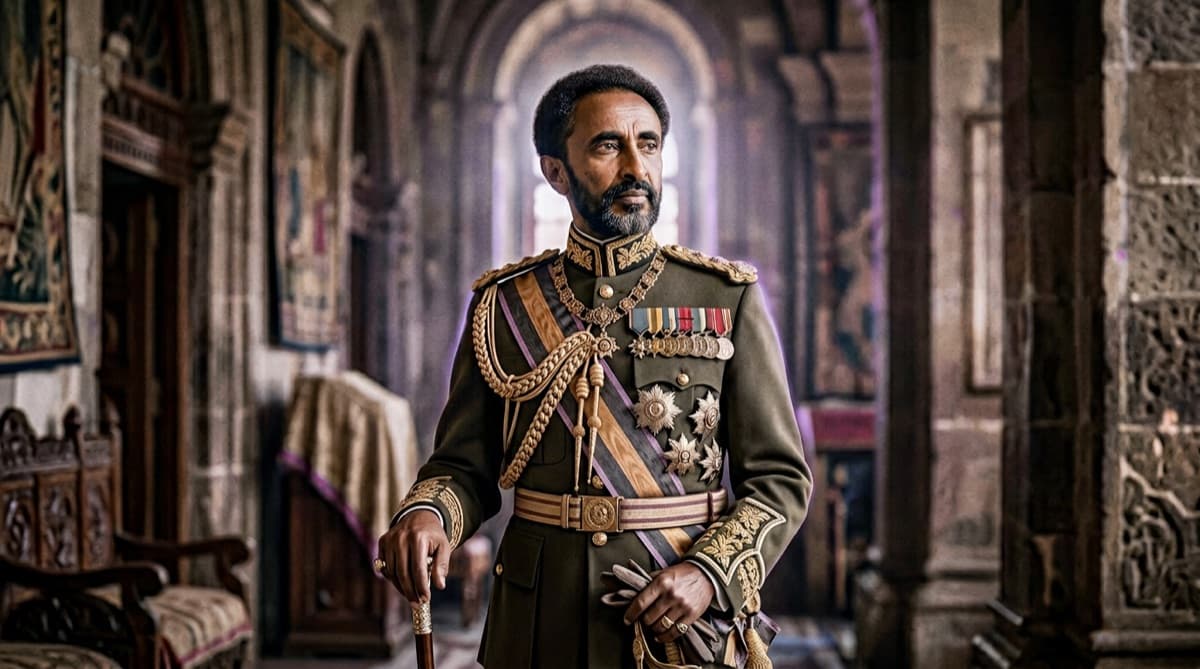
A hundred thousand people stood on a Caribbean runway in 1966, drumming, chanting, and smoking so much ganja that the air itself had turned hazy green. The plane had landed. The door opened. And the man they believed to be God took one look at the crowd, stepped back inside, and refused to come out.
That scene — chaotic, euphoric, theologically absurd — is the perfect entry point into Rastafari: a religion born on a small island, built from fragments of the Bible, African memory, and colonial fury, that turned a common weed into a sacrament and an Ethiopian emperor into a living deity. Whether he liked it or not.
A prophecy, a coronation, and an accidental messiah
The story begins with Marcus Garvey — Jamaican activist, pan-African visionary, and the man whose words would ignite a religion he never intended. In the 1920s, Garvey told his followers: "Look to Africa, where a Black king shall be crowned, for the day of deliverance is near."
On November 2, 1930, it happened. Ras Tafari Makonnen — a young Ethiopian nobleman — was crowned Emperor of Ethiopia, taking the title Haile Selassie I, which translates to "Might of the Trinity." His full ceremonial titles read like a passage from Revelation: King of Kings, Lord of Lords, Conquering Lion of the Tribe of Judah. He claimed descent from King Solomon and the Queen of Sheba — the 225th monarch in an unbroken Solomonic line.
In Jamaica, a group of preachers — Leonard Howell, Joseph Hibbert, Archibald Dunkley — heard the news and recognized what they believed was prophecy fulfilled. Revelation 5:5 spoke of the "Lion of the tribe of Judah" who would open the sealed book. Here he was, crowned in Addis Ababa, wearing the titles word for word.
The religion that grew from this moment was named after the emperor's birth name: Ras Tafari. "Ras" means "head" or "duke" in Amharic. "Tafari" means "one who is revered." The movement's God had a name, a face, an address, and diplomatic relations with the United Nations.
The First Rasta and the commune on the hill
Leonard Howell — later known as "The Gong" — is often called the First Rasta. Starting in 1933, he preached that Selassie's coronation meant redemption for the African diaspora. He published a book called The Promised Key and began organizing communities.
In 1940, Howell established Pinnacle, a commune in the hills of Saint Catherine Parish, Jamaica. It was part farming settlement, part spiritual experiment, part thorn in the side of British colonial authorities. Pinnacle became the first organized Rastafari community — and the place where ganja cultivation and communal smoking became central to the faith.
Here is one of history's small ironies: Howell himself never wore dreadlocks, the hairstyle that would become the movement's most recognizable symbol.
"Every herb bearing seed": the Biblical case for ganja
Rastafari is not a religion that happens to tolerate cannabis. Cannabis — called ganja, the holy herb, kaya, or wisdom weed — sits at the theological center. Rastas do not smoke recreationally; they smoke as a sacrament, a means of communion with Jah (God), and a tool for spiritual reasoning.
The Biblical justification runs deep:
-
Genesis 1:29 — "I have given you every herb bearing seed, which is upon the face of all the earth... to you it shall be for meat."
-
Genesis 3:18 — "Thou shalt eat the herb of the field."
-
Psalm 104:14 — "He causeth the grass to grow for the cattle, and herb for the service of man."
-
Proverbs 15:17 — "Better is a dinner of herbs where love is, than a stalled ox and hatred therewith."
-
Revelation 22:2 — "The leaves of the tree were for the healing of the nations."
For Rastas, these verses are not metaphors. When God said "every herb bearing seed," He meant every herb — including the one growing in the Jamaican hills. The reasoning is direct, unironic, and carries the weight of a commandment.
Reasoning sessions: theology in a cloud of smoke
Cannabis use in Rastafari is rarely solitary. The central ritual is the reasoning session — a communal gathering where Rastas share a chalice (a large water pipe) and discuss scripture, philosophy, and the state of the world.
The chalice is passed in a circle. Before lighting, a prayer is offered to Jah. The smoke is considered a vehicle for clarity and insight, not an escape from reality. In Rastafari theology, Babylon — the corrupt system of Western materialism — clouds the mind. The herb clears it.
These sessions can last for hours. The tone is earnest. The theology is real. You might disagree with the premise, but you cannot call it frivolous.
Iyaric: the language that rewrites reality
Rastafari did not stop at reinterpreting scripture. They rewrote the English language itself.
The dialect is called Iyaric (also known as Dread Talk). Its premise is radical: English was imposed on enslaved Africans as a tool of control. Words carry vibration and spiritual power. Therefore, syllables that sound "negative" must be replaced with life-affirming ones.
The results are striking:
-
"Overstand" replaces "understand" — because knowledge requires being over, not under
-
"Livication" replaces "dedication" — because the syllable "dead" has no place in devotion
-
"Downpression" replaces "oppression" — because oppression pushes down, not up
-
"I and I" replaces "we," "you and I," and sometimes even "me" — because Jah is present in every person, and dividing people with pronouns is dividing the divine
"I and I" is the cornerstone. As Rastafari scholar E. E. Cashmore wrote: "I and I is an expression to totalize the concept of oneness — the oneness of two persons. God is within all of us and we're one people."
This is not slang. It is a conscious, systematic decolonization of language through phonetics — an act of linguistic resistance that predates academic postcolonial theory by decades.
The colors, the hair, and the food
Rastafari is one of the most visually recognizable faiths on Earth. The red, gold, and green — borrowed from the Ethiopian flag — appear on everything from knit caps to murals:
-
Red — the blood of African martyrs
-
Gold — the wealth of Africa
-
Green — the vegetation of the homeland
Dreadlocks trace back to the Nazirite vow in the Bible. Numbers 6:5: "No razor shall come upon his head... he shall let the locks of the hair of his head grow." Samson — the biblical strongman who lost his power when his hair was cut — is a Rasta icon. Dreadlocks are not a fashion choice; they are an oath.
But the Nazirite vow is only half the story. Dreadlocks carry a second, equally powerful meaning: the refusal to conform to Babylon's standards of beauty. In colonial Jamaica of the 1930s and 1940s, Black men and women were pressured to straighten their hair, wear European-style suits, and mirror the grooming of their rulers. To grow your hair into matted, uncut locks was to say — with your body, every day, without uttering a word — I reject your system.
This is a point outsiders often miss. The entire Rastafari aesthetic is not a style. It is livity — a Rasta concept meaning a way of living that makes the separation from Babylon visible and total. The knitted tam (cap) in red, gold, and green is not an accessory; it covers the crown — the top of the head where the locks gather, the place where divine energy is believed to reside. Long, flowing robes and loose garments in earth tones or African prints replace the suits and ties of Babylon's corporate culture. Jewelry is minimal or absent. Shoes are often sandals, or none at all.
The logic is consistent: if Babylon is the system that enslaved, exploited, and dehumanized, then every element of Babylon's dress code is suspect. A clean shave, a pressed shirt, a leather briefcase — these are the uniform of the oppressor. Rastas do not wear them for the same reason they do not eat processed food or trust Western institutions: to look like Babylon is to become Babylon. The visual difference is not accidental. It is a walking, breathing theological statement — a daily declaration that the wearer belongs to Zion, not to the system that tried to erase them.
Ital food — from "vital" minus the first syllable — refers to the Rastafari diet: natural, unprocessed, and often vegetarian. Strict Rastas avoid pork, shellfish, alcohol, and anything artificial. The body is a temple; what enters it matters.
April 21, 1966: when God came to Kingston and hid in the plane
Now we return to that extraordinary scene at the airport.
Emperor Haile Selassie's state visit to Jamaica on April 21, 1966 became one of the strangest episodes in modern religious history. When his Ethiopian Airlines jet touched down at Palisadoes Airport in Kingston, an estimated 100,000 Rastafari had gathered on the tarmac.
They had broken through security barriers. They were drumming. They were chanting. The air was thick with ganja smoke — a literal haze of sacramental devotion. When the plane door opened and Selassie appeared at the top of the stairs, the crowd surged forward with such force that he retreated back into the cabin.
For somewhere between thirty minutes and an hour, the man whom these people worshipped as the returned Messiah sat inside the plane, unable or unwilling to descend. Jamaican officials, panicking, sent a Rastafari elder named Mortimer Planno up the stairs to negotiate. Planno reportedly told the crowd: "The Emperor has instructed me to tell you to be calm. Step back and let the Emperor land."
The crowd parted. Selassie descended. Witnesses say he was visibly moved — some accounts say there were tears on his face. Rita Marley — Bob Marley's wife — was in the crowd that day, and she later said the experience converted her to Rastafari on the spot.
The date is now celebrated as Grounation Day, the second holiest holiday in the Rastafari calendar, after Coronation Day on November 2. The word "grounation" refers to the moment Selassie's feet touched Jamaican ground.
The God who said he wasn't God
Here is the paradox at the heart of the faith.
Haile Selassie was an Ethiopian Orthodox Christian. He attended church. He built cathedrals. He never encouraged worship of himself. In a 1967 interview during a visit to Canada, he said plainly: "I have heard of that idea. I told them clearly that I am a man, that I am mortal, and that I will be replaced by the oncoming generation, and that they should never make a mistake in assuming or pretending that a human being is emanated from a deity."
The Rastafari response? His denial confirmed his divinity. A true messiah, they reasoned, would be humble enough to deny it. The more Selassie protested, the more certain they became.
When Selassie was overthrown in 1974 and reportedly died in 1975 under the Derg military regime, Rastas faced a theological crisis — but many simply refused to accept that he was dead. Some believe he lives on in spirit. Others regard his "death" as another test of faith.
This is a religion that does not bend easily to contradictions. It absorbs them.
Bob Marley: the apostle with a guitar
No account of Rastafari is complete without Robert Nesta Marley. Born in 1945 in Nine Mile, Jamaica, to a white British naval officer and a Black Jamaican woman, Marley became the most effective missionary any religion has ever produced — not through sermons, but through songs.
Get Up, Stand Up. Redemption Song. One Love. Exodus. Through reggae, Marley carried Rastafari theology to every continent. His music preached Jah, denounced Babylon, and celebrated the herb — all in melodies that made you move whether you understood the message or not.
Here is one more twist: on his deathbed in 1981, Bob Marley was baptized into the Ethiopian Orthodox Church — the same faith Selassie belonged to, not the Rastafari movement that worshipped Selassie as God. The religion's greatest ambassador made a final spiritual choice that his followers do not always discuss.
Three mansions under one roof
From the outside, Rastafari looks monolithic. From the inside, it contains at least three distinct branches — called mansions — that disagree on almost everything except Jah and Selassie.
Nyahbinghi is the oldest order: traditional, elder-led, built around ritual drumming and long communal gatherings called "groundations." These are the Rastas you picture first — dreadlocks visible, chanting deep into the night.
Bobo Ashanti, founded in 1958 by Emmanuel Charles Edwards, is the strictest mansion. Its members cover their dreadlocks with bright turbans and wear long robes — a visual contradiction that startles anyone expecting the classic silhouette. They maintain separatist communes (the most famous in Bull Bay, Jamaica), follow an enhanced Ital diet that excludes even mangoes and sugarcane, and fast twice a week. They see themselves as the priestly order of Rastafari.
Twelve Tribes of Israel, founded in 1968 by Vernon Carrington (known as Prophet Gad), is the most liberal mansion. Members are assigned to one of twelve biblical tribes based on their birth month, each with its own color. Unlike the other two, the Twelve Tribes extend salvation through Selassie to all races, not exclusively people of African descent. Bob Marley belonged to this mansion.
Three branches, one faith, zero central authority. The disagreements are real — and they are part of what keeps the movement alive.
Babylon, Zion, and the dream of return
Rastafari theology divides the world into two poles:
-
Babylon — the system of Western colonial oppression, materialism, corruption. The police, the banks, the governments that enslaved Africans and continue to exploit them.
-
Zion — Africa, specifically Ethiopia, the promised land. The place of return, healing, and spiritual wholeness.
The dream of repatriation — a physical return to Africa — runs through the faith. And unlike most religious promises, this one came with a deed.
In 1948, Haile Selassie granted 500 acres of fertile land in Shashamane, Ethiopia, to Black people of the diaspora — a gesture of gratitude for international support during Italy's invasion of Ethiopia. The first settlers arrived in 1955. After Selassie's electrifying 1966 visit to Jamaica, the trickle became a stream: Jamaican Rastas packed their lives and sailed toward the promised land. Bob Marley himself visited Shashamane in 1978, cementing its spiritual significance.
Then came the blow. After Selassie's overthrow, the Derg military regime nationalized the land in 1975. Of the original 500 acres, only 100 were eventually returned. The community, which had grown to around 2,000 in the 1990s, has since dwindled to a few hundred. Many relocated to Addis Ababa or left Ethiopia entirely.
There is a bitter irony here: the emperor's own advice during his Jamaica visit was "liberation before repatriation" — build your life where you are before chasing the promised land. The promised land, it turned out, had its own politics.
But for most Rastas, the return is as much internal as geographical. Zion is a state of consciousness. Babylon is the noise you learn to silence.
A faith that refused to die
Rastafari has no pope, no central authority, no single creed. It has been ridiculed, criminalized, misunderstood, and commercialized. Its adherents have been arrested for their sacrament, mocked for their beliefs, and reduced to souvenir shop cliches.
And yet it endures. Estimates place the global Rastafari population at roughly 700,000 to 1 million, spread across Jamaica, the Caribbean, Africa, Europe, and beyond. UNESCO recognized Reggae music — inseparable from Rastafari — as an Intangible Cultural Heritage of Humanity in 2018.
And the faith surfaces in places you would never expect. In Japan, a small but devoted Rasta community has existed since the late 1970s. Shops selling Ital food, reggae vinyl, and Rastafari literature opened in Tokyo and Osaka. Open-air reggae festivals called "Japan Splashes" drew thousands. After the Fukushima nuclear disaster in 2011, Japanese Rastas joined the anti-nuclear movement — reggae musician Sing J Roy recorded tracks about community rebuilding in Fukui Prefecture. Babylon, it seems, takes different forms in different hemispheres — but the impulse to resist it is universal.
The faith built from a prophecy, a coronation, a handful of Bible verses, and a plant that grows wild in tropical soil has proven surprisingly durable. Perhaps because it answers a question that organized religion often fumbles: what if the sacred is not locked in a cathedral, but growing in the ground beneath your feet?
Cannabis culture intersects with religion, history, and law in ways that resist simple answers. Whether Rastafari's reading of Genesis convinces you or not, the movement's story — from colonial Jamaica to global recognition — is a reminder that the relationship between humans and plants is never just botanical. At LIBRARY we treat this intersection as what it is: a field of knowledge worth exploring honestly.
Read more: FAQ · Catalog — education and assortment within Thai law.
Quick Answer
Rastafari treats cannabis as a biblical sacrament, citing Genesis 1:29 and Psalm 104:14; the faith was born in 1930s Jamaica when Haile Selassie's coronation was seen as prophecy fulfilled.