Did Philosophers Smoke? Cannabis, Consciousness, and the Dream of Expanded Perception
Philosophy has always wanted the same impossible thing: to move beyond the obvious. To tear the thin membrane of habit through which human beings usually look at the world, and for one moment see not the ordinary order…
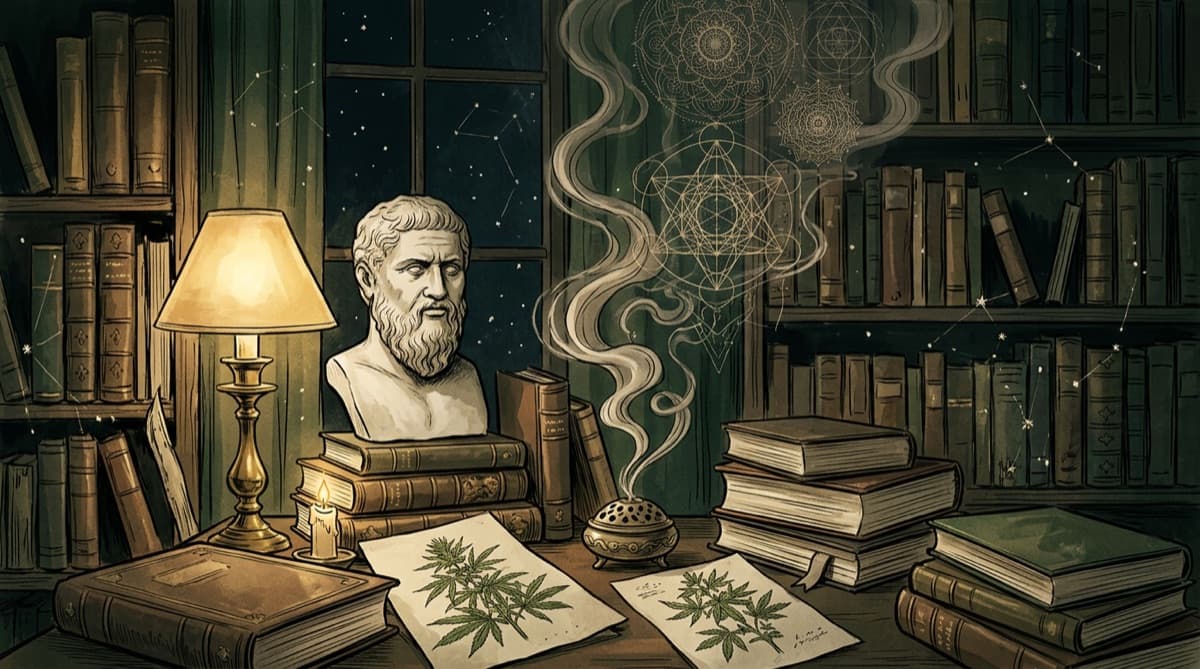
Philosophy has always wanted the same impossible thing: to move beyond the obvious. To tear the thin membrane of habit through which human beings usually look at the world, and for one moment see not the ordinary order of things, but something deeper, stranger, more original. Hence the old attraction of thinkers to caves, vigils, ritual, fasting, ecstasy, prayer, music, wine, smoke, silence. And, inevitably, to the hope that there might be a shortcut to places philosophy usually reaches only on foot.
So, did philosophers smoke cannabis? Sometimes yes. Sometimes no. But the real value of the question is not as gossip about a secret substance of wisdom. It matters because it opens a much older story: why human beings have so often hoped that an altered state of consciousness might bring them closer to truth.
Not a hidden order, but a permanent temptation
It is tempting to imagine history as a concealed line running from ancient sages to nineteenth-century bohemia and then to the counterculture of the twentieth century, as though every genuine thinker searched for revelation in smoke, resin, or potion. But that would be too convenient, and too literary.
Philosophers were never a single brotherhood of “expanded perception.” Some looked for truth through discipline of reason. Others were drawn to mystical experience. Some trusted clarity as one trusts geometry. Others suspected that clarity itself was too narrow, and that ordinary waking consciousness could not possibly exhaust the range of human experience.
And yet the temptation never went away. If truth is hidden behind habit, could a substance break habit? If perception is trapped inside the everyday, could smoke open a small hidden door?
The old dream of another mode of seeing
Long before modern academic philosophy, there was an older intuition: consciousness does not have to remain only one thing. Historical reviews of India show cannabis not merely as a plant, but as part of ritual, medical, and religious contexts. That is not philosophy in the narrow university sense, but it already carries a major idea: human beings can inhabit different modes of awareness, and some of those modes are felt to be denser, more revelatory, or more sacred than ordinary life.
This is where the great dream begins, the one that later haunts poets, mystics, psychologists, and philosophers alike: what if an altered state does not merely distort reality, but reveals a hidden layer of it?
Why the canonical philosophers mostly stay silent
If we move to the classic European canon, the picture becomes much stricter. Descartes, Spinoza, Kant, Leibniz, and Hegel did not leave behind a tradition of “philosophical cannabis.” The great project of early modern thought was built on method, logic, proof, and concept. Truth was supposed to emerge from disciplined thought, not from fog.
And yet even this severity had its crack. The more confidently philosophy elevated reason, the more insistently a question returned: is reason itself too narrow? Do we mistake the familiar for the true simply because we keep encountering the world in the same register?
That is part of why the nineteenth century became so fascinated with dreams, hallucination, hypnosis, mysticism, intoxication, divided consciousness, madness, and inspiration. It was an age in which philosophy, literature, and early psychology all approached the same border.
Baudelaire, Gautier, and the intellectual style of altered perception
This is where cannabis begins to matter as a serious cultural subject. Around hashish in nineteenth-century Paris there emerged not only decadent style, but an almost philosophical frame. Theophile Gautier, and later Baudelaire, were interested not merely in scandal, but in what altered states do to time, memory, fear, image, and inner speech.
Baudelaire matters especially here. His Artificial Paradises is valuable precisely because it refuses both naive enthusiasm and simple moralism. He understood the central danger of the temptation: the substance promises not only pleasure, but revelation. It whispers that you have been living in a cramped room and are about to be shown a palace.
And there lies the philosophical problem. One can never fully prove whether that palace was reality, a genuine enlargement of experience, or only a magnificent stage set built by consciousness itself.
William James and intellectual honesty about multiple consciousness
At the start of the twentieth century, William James gave that issue one of its most memorable formulations. In The Varieties of Religious Experience, he argues that our normal waking consciousness is only one special type of consciousness, while other forms lie nearby, separated from it by only the flimsiest screen.
That does not make James a philosopher of cannabis. But it does mean he provided a language for the question that would echo through later culture: if ordinary consciousness is not the only form, are we not obliged to take other states seriously?
From that point on, cannabis entered not only the history of pleasure, but the history of an epistemological temptation: the dream of knowing the world not merely more intensely, but otherwise.
Expanded perception or elegant confusion?
Here the difficult boundary appears. Cannabis can indeed change the pattern of attention: scent grows layered, music more spatial, time thicker, thought more associative. A person may feel, perhaps sincerely, that they are noticing the hidden architecture of memory, language, feeling, and the body for the first time.
But the feeling of depth is not always the same as depth. That is the central philosophical lesson in this whole history. A substance may intensify experience, lend thought the glow of discovery, make a sentence sound like revelation. Yet there remains a distance between the experience of truth and truth itself.
Philosophy stays severe at exactly this point. It is interested not only in what feels momentously true in the instant, but in what survives the return to daylight, to language, to argument, to testing.
Still, it would be too easy to dismiss everything and say that altered states are therefore mere illusion. That would also be shallow. Their importance lies in the way they expose the fragility of the norm itself. They remind us that what we call “ordinary” is not transparent reality, but one historically habitual way of being conscious in the world.
What thinkers were really seeking
Seen honestly, serious thinkers were usually looking not for a magic substance, but for a way out of the banality of perception. For some, that way was prayer. For others, meditation. For others, poetry, music, eroticism, fasting, ecstasy, art, revolution, monastic discipline, or psychoanalysis. Cannabis is only one version of an old human attempt to move beyond the habitual self.
That is why the question “did philosophers smoke?” is too small for the real subject. The more interesting question is why thought, century after century, cannot stop returning to the suspicion that there is a gap between ordinary consciousness and the fullness of the world.
So, did philosophers smoke?
Sometimes yes. But what matters far more is that philosophy repeatedly approached the same problem that attracts mystics, poets, artists, and psychonauts: can one step beyond the ordinary regime of perception without losing the ability to distinguish revelation from mirage?
That is the true theme. Not the pipe, not the legend, not the fantasy of a hidden brotherhood of wise men, but the permanent tension between clarity and the seduction of revelation.
Human beings do not want merely to live in the world. They want to see it more deeply. Cannabis became, in that story, one of the symbols, instruments, and myths. Not a universal key to truth. But part of the long conversation about how consciousness dreamed of exceeding itself.
At LIBRARY, what interests us is not the myth of a philosopher’s drug, but the history of that desire itself, where thought, language, literature, and experience touch. Not as a shortcut to wisdom, but as an occasion to ask, dear reader, what we really mean by clarity, and how often we mistake the familiar for the final truth.
LIBRARY editorial voice
We do not treat altered states as a replacement for thinking, and we do not romanticize smoke as a philosophical argument. But we do take the cultural history of consciousness seriously. Cannabis matters here not only as a plant, but as part of the long human attempt to break through the habitual regime of perception. If you want to continue the investigation, visit the FAQ, the catalog, and the LIBRARY blog like shelves in a library where the most dangerous books were often not locked away, but simply filed under the wrong heading.
This material is for informational purposes only and does not replace medical or legal advice. Always follow local law.
Quick Answer
There is no single tradition of philosophers using cannabis, but the plant became part of a larger cultural and philosophical question: can altered states widen perception without confusing intensity with truth?