Ropes of Empires: The Hemp That Built the Fleet
At night, admiralty offices did not think in poetry. They counted rope, inspected wet rigging, and listened to timber complain under the wind. In the seventeenth and eighteenth centuries, empires understood a hard truth…
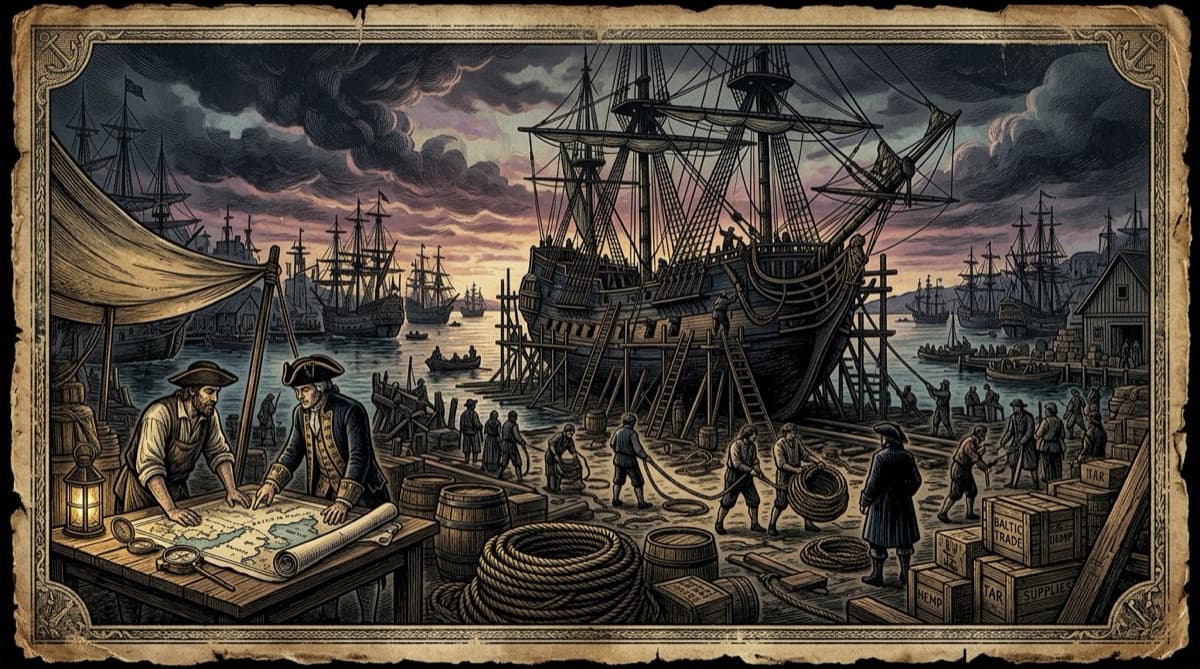
At night, admiralty offices did not think in poetry. They counted rope, inspected wet rigging, and listened to timber complain under the wind. In the seventeenth and eighteenth centuries, empires understood a hard truth: fleets did not rest on cannons and captains alone, but on coarse fibers twisted into miles of cordage. If the rope snapped, the yard came down. If the yard came down, the ship lost its voice. And if the fleet stopped moving, the empire itself began to loosen.
That is where this story begins: with a plant that rarely gets top billing in heroic history, yet helped carry the maritime power of the world for generations. It is the story of hemp / cannabis as one of the strategic materials of the Age of Sail.
1. An empire begins not with a crown, but with a rope
Today, when we picture naval powers, we remember admirals, battles, and colonies. But before any of that, the sailing world had to answer a blunter question: what would hold the ship together? What would become cables, rigging, lines, moorings, netting, and heavy canvas for sea service?
That is where hemp entered the scene. Its fiber was prized for strength, flexibility, and usefulness in hard maritime conditions. Rope was tarred, dried, stored in vast ropewalks, and hauled aboard where almost every movement depended on it: raising sail, bracing yards, securing cargo, anchoring, towing, surviving storms.
Yes, the best sailcloth was often associated with flax, and naval canvas varied by time and place. But without hemp cordage, a fleet still lost its spine. A warship could be splendidly armed and perfectly crewed, yet without rigging it became a floating fort trapped in harbor.
2. Britain, Russia, Spain: three empires, one indispensable plant
In the account books of empire, hemp appeared not as a curiosity but as a matter of survival. Britain, whose power increasingly rode on the sea, needed enormous volumes of fiber for dockyards and ropeyards. The famous British naval machine of the eighteenth century was not purely “insular”; it depended heavily on imported Baltic hemp, which meant dependence on Russian supply.
That gave Russia a very different role in imperial history: not merely a northern land empire, but a supplier of the raw material without which foreign fleets began to slow and fray. Russian and Baltic hemp became strategic cargo. It moved through trade routes, contracts, and ports like a quiet form of power.
Spain, whose monarchy relied on oceanic routes, silver, colonies, and armed fleets, had no luxury of treating hemp as a rural afterthought. The Spanish world also had to secure access to fiber and naval stores, because the lines of empire did not run only through thrones and treasure. They also ran through warehouses full of cordage and canvas.
That is why hemp in this period was not “just a plant in a field.” It was part of the nervous system of global logistics.
3. The war behind the war: supply fights, sabotage, and smuggling
The moment a material becomes strategic, it attracts a second cast of characters: smugglers, speculators, saboteurs, and bureaucrats who understand that power can be weakened long before the first cannon fires. Hemp was no exception.
Baltic trade routes became something like a chessboard. Merchants bargained, officials counted stock, dockyards demanded urgent deliveries, and rival states understood a brutal lesson: sometimes you did not need to sink the enemy’s ship. You only had to interrupt the rope supply and wait.
That opened the door to the entire shadow economy of the era:
-
smuggling, when strategic fiber moved where crowns did not want it to move;
-
sabotage, when damage was done not at sea but inside the supply chain;
-
speculation, when hemp prices carried almost the same nervous energy as armaments;
-
diplomatic pressure, because hemp markets were tied to state relations as tightly as formal treaties.
So the history of fleets is not only the history of gun smoke. It is also the history of depots, ropewalks, wet dockyards, missing shipments, forged paperwork, and men who knew how much destruction could begin with a single broken line.
4. Why this plant mattered so much
The explanation is less romantic than material. Hemp mattered because it worked.
-
It was central to rope and rigging.
-
It was suited to the rough routines of maritime service.
-
It belonged to a huge infrastructure stretching from field to ropewalk to arsenal.
-
Together with flax, tar, timber, iron, and canvas, it formed part of the larger world of naval stores.
If you imagine a sailing warship as a living body, oak was its bone, iron its joints, and hemp its tendons and veins. Empires needed thousands of such veins at once.
5. The plant that held empires together
That is why the story of hemp in the seventeenth and eighteenth centuries reads almost like an adventure novel, even though the mechanics are perfectly real. It has northern ports, storm-dark warehouses, immense coils of rope, officials with seals, merchants with double ledgers, saboteurs, smugglers, and admirals who knew that an expedition might fail not on the gun deck, but the day a shipment of fiber failed to reach port.
We like to tell the story of empire in the language of crowns, treaties, treasure, and victory. But sometimes it is truer to tell it in the language of materials. Then we discover that world power rested not only on gold and iron, but also on humble hemp twisted into line.
And if there is a literary moral here, it is this: the quietest things are often the ones holding history together.
LIBRARY editorial voice
So, dear reader, the next time you hear the word “cannabis,” try imagining not only modern debates but an imperial harbor in the rain, where the fate of a squadron could depend on a single shipment of fiber. If you want to continue the investigation, visit the FAQ, browse the catalog, and turn through the LIBRARY blog like a favorite volume, one chapter smelling of tar, paper, salt, and time.
Informational only; not legal or medical advice. Always follow local law.
Quick Answer
In the Age of Sail, hemp was a strategic naval material for rope, rigging, and maritime supply systems; without cordage, fleets weakened, and without fleets, empires lost reach.