Opium, Hashish, and the Secret Clubs of Paris
Paris adored locked doors, whispered names, and rooms entered only after midnight. The carriage stopped on the Ile Saint-Louis, the river breathed below the stone embankment, and somewhere behind a noble facade a green…
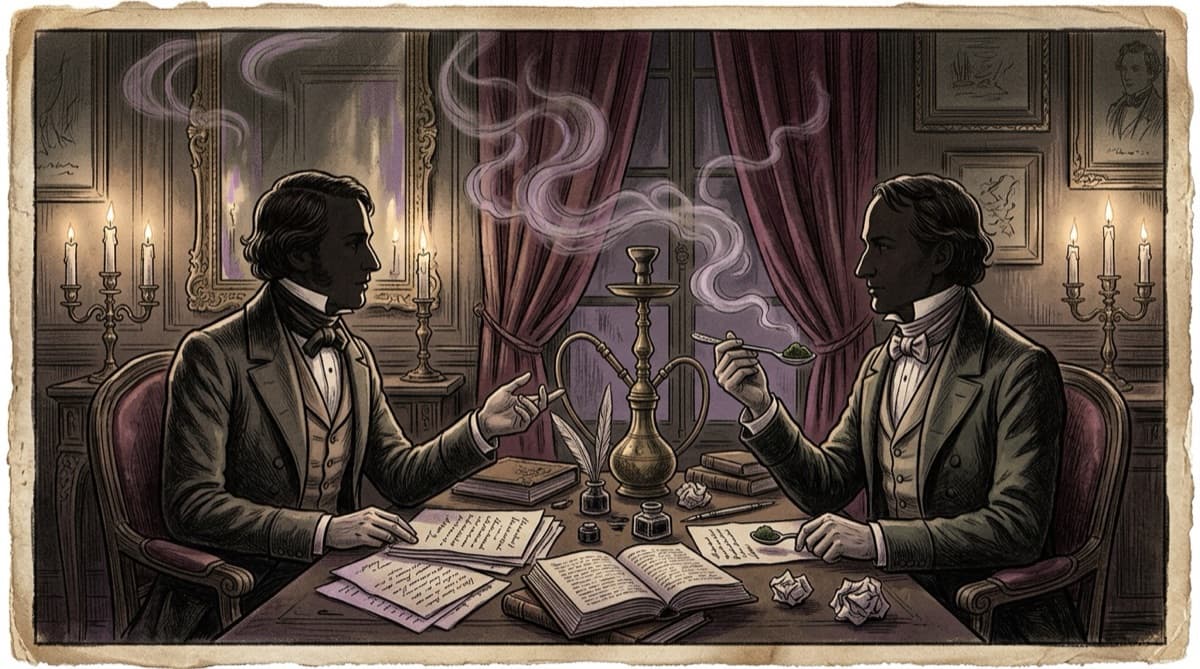
Paris adored locked doors, whispered names, and rooms entered only after midnight. The carriage stopped on the Ile Saint-Louis, the river breathed below the stone embankment, and somewhere behind a noble facade a green paste waited on a silver spoon. Outside: wet quays, police lamps, gossip, and the ordinary dirt of the capital. Inside: velvet, mirrors, philosophy, theatre, and the suspicion that the human mind itself might be the greatest unsolved crime scene in France.
This is the atmosphere that later hardened into legend as the Club des Hashischins. Not quite a criminal brotherhood, not merely a salon, not simply a medical experiment, it hovered between all three. Which is why the story still feels so alive: it is historical fact wearing the costume of an adventure novel.
The hidden door on the Ile Saint-Louis
The meetings are tied above all to Hotel Pimodan on the Ile Saint-Louis and to Dr. Jacques-Joseph Moreau de Tours, who studied the effects of hashish on the mind. This already gives the club its unusual tension. On one side stood medicine, curiosity, and observation. On the other stood performance, taste, literary vanity, and the Parisian hunger for exotic forms of revelation.
The guests did not arrive merely to consume. They arrived to witness, to test, to compare, to narrate, to return later and turn sensation into prose. That is why the place matters so much. A hashish gathering in a shabby back room would tell one story. A hashish gathering in an aristocratic interior draped in luxury tells another: that consciousness itself has become a fashionable frontier.
Dawamesk, chandeliers, and the theatre of the mind
The famous preparation was dawamesk, a hashish mixture that already sounded half medicinal and half ceremonial. Around it: candlelight, carved walls, orientalizing decor, expensive fabrics, dark reflections in mirrors. The room did not merely host an experiment. It staged one.
And that theatricality is essential. The club fascinates not because it was “decadent” in a lazy modern sense, but because it turned altered perception into a social performance. Sensation was not only felt; it was discussed, framed, compared, and later rewritten. The trip began in the body and ended on the page.
Baudelaire, Dumas, and the luxury of danger
Then come the names that make the whole scene feel larger than life: Charles Baudelaire, Alexandre Dumas, Theophile Gautier, Gerard de Nerval, and others drifting through the orbit. Once those names gather in the same room, the club stops sounding like a curiosity and starts sounding like the opening chapter of a literary conspiracy.
Baudelaire is the most haunting figure here. He matters not because he was the loudest participant, but because he became one of the sharpest interpreters of the temptation itself. In Artificial Paradises, he would later write about hashish and opium not as cheap thrills, but as false doors to transcendence: seductive, brilliant, dangerous, and never free.
Dumas contributes something different. With him, the scene acquires scale and velocity. If Baudelaire adds philosophical depth, Dumas adds the feeling that any dinner might turn into a plot, any spoon into a clue, any salon into the headquarters of an invisible order.
Opium in the wallpaper, hashish on the spoon
The title of this article carries both opium and hashish, and that pairing must be handled carefully. Historically, the Club des Hashischins belongs above all to the story of hashish. Yet Paris in the mid-nineteenth century was already saturated with opium dreams, Orientalist rooms, colonial circuits, imported fantasies, and the literary glamour of “artificial heavens.”
So even when opium was not the central rite of the club, it haunted the atmosphere around it. It was in the books being read, in the décor being imitated, in the borrowed East imagined by Parisian taste. Hashish sat on the spoon. Opium lingered in the wallpaper.
Moreau de Tours: scientist or ringmaster?
This is where the story becomes especially good. Moreau de Tours appears as a physician, a man of method, someone who wanted to understand the mind through induced experience. And yet, in this setting, even science acquires velvet cuffs. The doctor is also a kind of ringmaster. He does not merely record effects; he helps arrange the circumstances in which they become unforgettable.
That ambiguity is part of the club’s enduring magnetism. Was this psychiatry? A private spectacle? A laboratory for literature? The answer is not tidy, and perhaps should not be. The Club des Hashischins sits precisely in that unstable borderland where observation, performance, vanity, and revelation all use one another.
Why the legend refuses to die
That is why the story still grips. Not because it was scandalous in some simple way, but because it exposed a permanent human temptation: to treat consciousness as unexplored territory and art as a passport across the border. Every age reinvents that dream. Nineteenth-century Paris simply did it with more velvet, more candlelight, and better prose.
This is not a guide to substances. It is closer to a psychedelic art-detective. The doctor observes. The poet doubts. The novelist enlarges the danger. The reader follows the trail without knowing whether it leads to insight, illusion, or both.
At LIBRARY, we care about cannabis culture not only as product or law, but as history, language, mood, and myth. The Paris hashish club belongs to that larger archive: a place where drugs, medicine, empire, fashion, and literature become impossible to separate cleanly.
LIBRARY editorial voice
No sensible reading of this history turns opiates into romance or salons into advice. But the episode deserves honest atmosphere as well as honest fact. Paris made a stage of nearly everything, and here it made a stage even of altered consciousness. If this leaves behind a flicker of curiosity, dear reader, continue the investigation in the FAQ, the catalog, and the LIBRARY blog like pages in a novel still scented with wax, river mist, and a trace of dangerous perfume.
This material is for informational purposes only and does not replace medical or legal advice. Always follow local law.
Quick Answer
The Club des Hashischins was a mid-19th century Paris salon at Hotel Pimodan where Moreau de Tours and literary guests explored hashish, while opium belongs more to the broader atmosphere of Baudelaire-era Paris than to the club’s main ritual.