The Quiet Inheritance: Tim Cook, and the End of an Era at Apple
On September 1, 2026, Tim Cook steps down as CEO of Apple and John Ternus takes over. A LIBRARY editorial on the quiet inheritance: the Alabama engineer who closed the warehouses, turned Jobs's myth into global infrastructure, and is now handing it to a man of hardware.
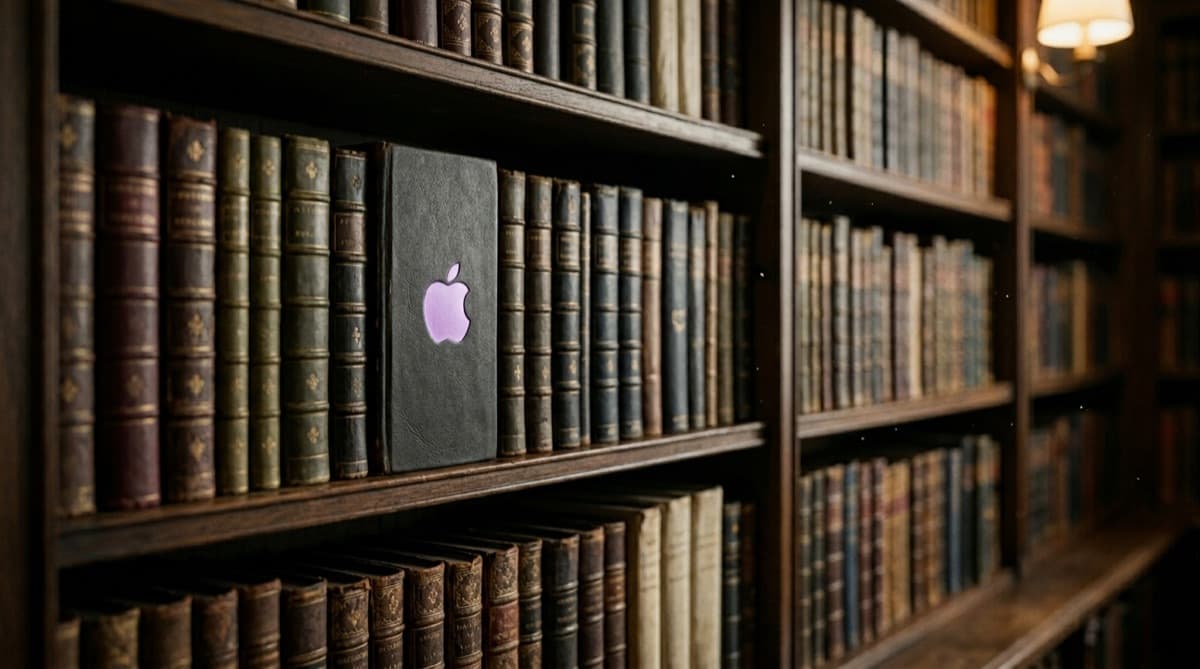
In the end, the most Apple thing about Tim Cook's exit from Apple was how Apple it was. No tears from the stage. No long monologue about what it has all meant. A press release, a quote, a succession plan, a date. On September 1, 2026, Cook steps down as CEO and becomes executive chairman. His successor, announced in April 2026, is John Ternus, the company's longtime head of hardware engineering.
It is the second transfer of power at Apple in just over twenty years — and this time, there is no sense of crisis in the room. No founder dying. No urgent search committee. Just the next name on the quiet internal depth chart sliding over.
Which, in a way, is the whole point. Cook's fifteen years at the top of Apple can be summarized in a single sentence: he made Apple into the kind of company where a succession no longer feels like an emergency.
The engineer from Alabama
Timothy Donald Cook was born on November 1, 1960, in Mobile, Alabama, and raised in Robertsdale, a small Gulf Coast town where his father worked at a shipyard and his mother at a pharmacy. It was, by any reading, a long way from Cupertino — culturally, economically, spiritually. He delivered newspapers, edited the school paper, and in 1982 graduated from Auburn University with a degree in industrial engineering. An MBA from Duke's Fuqua School followed in 1988, where he graduated as a Fuqua Scholar.
He has told the story many times, in commencement speeches and interviews, but it never quite loses its charge. As a teenager in rural Alabama, Cook drove past a cross burning on the lawn of a Black family's home, set there by the Klan. He shouted something in protest. He has said, more than once, that the experience taught him, permanently, to recognize injustice. Everything that comes later — the 2014 coming-out essay, the 2016 letter to the FBI, the unflagging public framing of privacy as a human right — begins on that Alabama road.
Twelve years at IBM followed, building personal computers in North Carolina and absorbing, from the inside, what lean manufacturing and just-in-time supply really meant. A stint at Intelligent Electronics. Then, famously, six months at Compaq — then the largest PC maker on Earth — as vice president of corporate materials. It is one of the stranger footnotes of his biography: the man who would spend the next three decades at Apple almost didn't leave Compaq in time to be there.
In March 1998, Steve Jobs called. Apple was not yet Apple. It was a company that had recently been saved — by Jobs's return, by an infamous $150 million investment from Microsoft, by the first stirrings of the iMac. Any rational career adviser would have told Cook to stay put. Cook has said he made up his mind within five minutes of meeting Jobs. The decision, eventually measured in trillions, was not a spreadsheet decision. It was instinct.
Closing the warehouses
Jobs did not hire Cook for vision. He hired him for discipline, and gave him the title of senior vice president for worldwide operations. Cook's first acts at Apple are still taught in business schools.
He closed, almost entirely, the company's finished-goods warehouses. His line about it has become a small industry classic: inventory, he said, is like the dairy business — if it sits too long, it spoils. Within a few years, Apple's inventory turns had collapsed from months to days. The company owned very few factories of its own. What Cook built instead was a virtual empire: contracts with Foxconn, Pegatron, TSMC; tens of thousands of sub-suppliers; quality and logistics control enforced halfway around the world at a level that had never really been attempted at this scale. Apple, improbably, had become a company that did not own its factories but ran them.
When Jobs went on medical leave — in 2004, again in 2009, and finally in January 2011 — Cook, not Jobs, ran Apple day to day. His reputation inside the company was by then fixed: 4:30 a.m. emails, personal reading of customer complaints sent to tcook@apple.com, a near-religious attention to operational metrics, a temperament that did not reward theatrics.
On August 24, 2011, Jobs sent the board his resignation letter: "I have always said if there ever came a day when I could no longer meet my duties and expectations as Apple's CEO, I would be the first to let you know. Unfortunately, that day has come." Cook took the title. Six weeks later, on October 5, 2011, Jobs was gone.
A different category of great
If Jobs ran Apple in the category of product, product, product, Cook chose a different category altogether: system, scale, endurance.
The numbers under his leadership are, at this point, almost absurd. Apple's market capitalization rose from roughly $350 billion in 2011 to about $4 trillion by 2026. Annual revenue went from $108 billion to $416.2 billion (FY2025). Apple was the first company in history to cross the $1 trillion mark (August 2, 2018), the first to cross $2 trillion (August 2020), and the first to cross $3 trillion (January 3, 2022). Those milestones did not exist, as corporate thresholds, before Apple walked through them.
To mistake Cook for a mere caretaker of Jobs's legacy, though, is to miss what happened on his watch.
Apple Watch (2014) turned the company into the world's largest seller of wristwear within a few years — and, less commented on but more consequential, into a serious participant in public health. Its ECG, fall detection, and crash detection features have by now accumulated a quiet archive of survival stories: people who learned they had atrial fibrillation because of a notification; hikers whose falls were reported when they couldn't call for help; drivers in wrecked cars whose watches dialed for them.
AirPods (2016) began as a mild joke and ended as a visual signature of the decade. As a standalone business line, AirPods alone generate revenue comparable to entire Fortune 500 companies.
Apple silicon (2020), announced at WWDC on June 22, 2020 alongside Craig Federighi and Johny Srouji, looked like a technical upgrade and was, in fact, a declaration of sovereignty. In severing the Mac from Intel and moving it onto chips Apple designed itself, Cook closed the loop the company had been tightening for a decade: hardware, software, and silicon, all inside one building. It was the kind of vertical integration no other major computing company had been willing — or able — to attempt.
Vision Pro (2024) was Cook's bet on spatial computing, his first serious attempt since the iPhone to open a genuinely new category. Commercially, so far, it is a modest thing. Strategically, it is his answer to the accusation that his Apple had stopped swinging at the fences.
- And beneath all of this, quieter than any keynote, a second Apple grew up: services. App Store, iCloud, Apple Music, Apple TV+, advertising, payments. In fiscal 2025, the services line generated $109.2 billion in revenue, up from $96.2 billion the year before. By 2023, Apple had crossed one billion paid subscriptions. Without ever quite saying so on stage, Cook had rewired the company's economics — away from discrete product waves, toward something that looked more like a utility.
Values that showed up on the balance sheet
It would be wrong to reduce the Cook era to supply chains and capital markets. Under him, Apple stepped — cautiously at first, then deliberately — into the public life of the country.
In October 2014, Cook published an essay in Bloomberg Businessweek containing the line he is still most often quoted on: "Being gay is among the greatest gifts God has given me." He was the first sitting CEO of a Fortune 500 company to come out publicly. For a corporation as institutionally private as Apple, it was not merely a personal statement. It was a cultural one.
In February 2016, after the San Bernardino attack, the FBI demanded that Apple build a special version of iOS to bypass the encryption on the attacker's iPhone. Cook's response — an open letter to customers titled "A Message to Our Customers" — became one of the most consequential public statements in modern corporate history. Apple refused. From that moment on, privacy stopped being a marketing line and became part of the product itself.
In 2020, the company committed to full carbon neutrality across its entire footprint — from mined raw materials to the device in your pocket — by 2030, a goal whose scale reads almost as hubris. That same year Apple removed the charging brick from the iPhone box, a decision simultaneously praised and mocked but unambiguously part of the era's environmental narrative.
Cook himself has pledged to give away essentially all of his fortune. For a CEO of his stature he lives in something close to restraint: a single home in Palo Alto, pre-dawn workouts, an almost monastic daily rhythm.
And then there is the building. Apple Park, 2.8 million square feet of glass ring in Cupertino, opened in April 2017 at a cost of roughly $5 billion. It was the last great unfinished project of Steve Jobs, who spent his final months obsessing over its details. It opened under Cook. In a way, that is the entire era in a single image: someone else's vision, finally brought to working order.
The honest ledger
No fair account of Cook leaves out the shadows.
On generative AI, Apple under Cook was visibly cautious and visibly behind. Apple Intelligence, announced at WWDC in June 2024 alongside a partnership with OpenAI, arrived after ChatGPT, Gemini, and Claude had already become household words. Whether Apple's on-device, privacy-first framing will read as wise or laggardly in retrospect is the open question his successor will have to answer.
Project Titan, the company's decade-long attempt to build a car, was quietly shut down in February 2024 after an estimated $10 billion in investment. It is the most expensive product failure in Apple's history and, arguably, the defining strategic mistake of the Cook years.
Apple's antitrust exposure grew in parallel with its size. The Epic Games trial of 2020–2021 cracked parts of the App Store's long-protected economics. In the European Union, the Digital Markets Act, effective March 2024, forced Apple to open iOS to alternative app stores for the first time.
China remained, throughout Cook's tenure, both the company's manufacturing base and its single largest political risk. Unlike Jobs, Cook has had to learn an art the company had not previously required: diversifying assembly. India, Vietnam, a slow structural rebalancing of supply. By 2025, a meaningful share of iPhones shipped globally are assembled in India — a shift that is, in every practical sense, his project.
The summary most historians will reach for is the one critics have been reaching for since 2013: Cook is a brilliant operator, not a visionary on the scale of Jobs. That will be correct, and incomplete. Most companies that lose founders of that magnitude drift into decades of decline. Apple, on Cook's watch, did not drift. It grew larger, stronger, richer, and more deeply woven into daily life on the planet. By the standards of the category, that is a historical anomaly in its own right.
Enter John Ternus
Which brings us to the successor.
John Ternus joined Apple in 2001, trained as a mechanical engineer, and started on the Product Design team — the discipline, inside Apple, most closely tied to how a thing actually feels in the hand. He became vice president of hardware engineering in 2013, and in January 2021 was promoted to senior vice president, succeeding Dan Riccio, who moved to Apple's AR/VR work. His portfolio, by the time he became CEO-designate, covered essentially everything the company ships: iPhone, iPad, Mac, Apple Watch, AirPods, Vision Pro. Apple itself has singled him out as one of the chief leaders of the Mac transition to Apple silicon.
For the past five years Ternus has been the public face of Apple hardware. He introduced the first M1 and M2 Macs on stage. He has presented recent iPad Pro generations. At WWDC in June 2023, it was Ternus, not Cook, who first said the words Vision Pro in public. Colleagues describe him as a lab-and-prototype engineer rather than a keynote man — someone famously attentive to the way an object sits in a palm, to fillet radii, to the temperature of surfaces, to the exact transition between two materials. For Apple, a company whose ideology of craftsmanship has always insisted that how something is made matters as much as what it is, this is the right kind of biography.
The choice is meaningful beyond simple continuity. Apple is entering an era in which hardware and AI are fusing into the same substrate: compute migrating on-device, neural networks living inside silicon, a headset becoming an extension of vision. A CEO trained in hardware engineering is not a neutral pick in that world. It is a statement about where Apple intends to win in the coming decade.
The symmetry, once you notice it, is difficult to unsee. Jobs handed the company to an operator. Cook is handing it to a hardware engineer. Jobs's instinct was to invent categories. Cook's was to turn categories into planetary infrastructure. Ternus's task will likely be the third in the sequence — fusing both — at a moment when simply shipping beautiful objects is no longer enough, when Apple will again have to explain, out loud, for what kind of future its devices exist.
The shelf
Jobs will be remembered as the man who lit Apple on fire. Cook will be remembered as the man who kept the fire from going out — and turned it, quietly, into the infrastructure of a large part of modern life. With time, that second act will be valued more, not less. Not as a second Jobs. As the first genuinely great heir to Jobs.
John Ternus, for now, is an empty page in the book. It will be written.
This piece belongs to LIBRARY's archive — where we note, on the record, the moments worth keeping: people, companies, eras, the occasional cultural inflection that deserves to sit on a shelf. Apple belongs on that shelf. So, here on it, is Tim Cook.
This is an editorial by LIBRARY. There is no financial, sponsorship, or commercial relationship with Apple Inc. behind this text. We simply love their products and enjoy them every day🫶
Quick Answer
Tim Cook will step down as Apple's CEO on September 1, 2026 and become executive chairman; John Ternus, Apple's longtime head of hardware engineering, takes over. Under Cook, Apple grew from around $350 billion to roughly $4 trillion in market capitalization and crossed the $1T, $2T, and $3T thresholds before any other company.