What Did Sherlock Holmes Smoke? A Literary Detective File
London fog settled over Baker Street like a witness with too many secrets. Tonight we are not hunting a murderer, a jewel thief, or a blackmailer. We are hunting smoke. What, exactly, did Sherlock Holmes smoke? A pipe,…
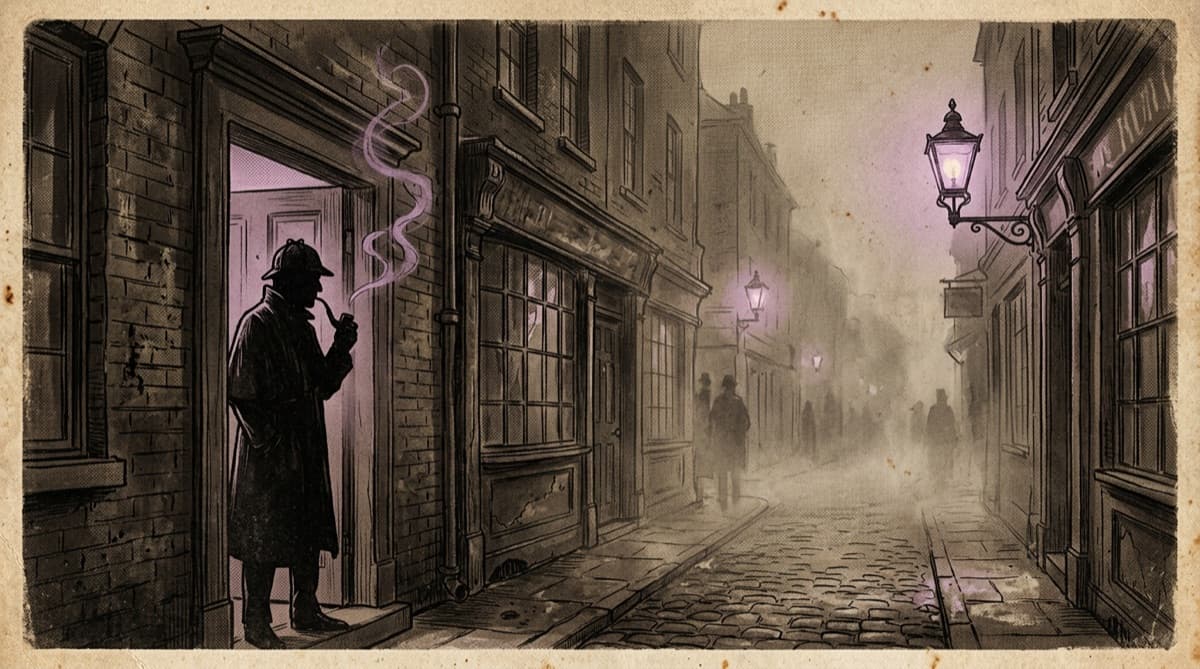
London fog settled over Baker Street like a witness with too many secrets. Tonight we are not hunting a murderer, a jewel thief, or a blackmailer. We are hunting smoke. What, exactly, did Sherlock Holmes smoke? A pipe, certainly. Tobacco, famously. Yet if you open Conan Doyle’s pages and follow the smell carefully, you find something stranger: cocaine on the table, morphine in the doctor's warning, opium in the shadows of the docks, and a detective who moves through all of it like a man reading clues in the dark.
The short answer is simple. The literary answer is far better.
The first clue: the famous seven-percent solution
The canonical shock comes in The Sign of the Four. Watson discovers Holmes with a syringe and hears the line that has haunted readers ever since: “a seven-per-cent solution” of cocaine. The scene lands with unusual intimacy. This is not a villain's vice exposed in chapter twelve. It is the great detective in his own rooms, coolly explaining that an unstimulated brain risks corrosion.
Watson, doctor and friend, is horrified. He asks whether it is morphine tonight or cocaine. With that question, Conan Doyle opens a door into late-Victorian ambiguity: substances that look medical, habits that sound intellectual, and a society not yet speaking in the language of modern addiction.
This is why Holmes's drug use still unsettles. He does not present it as pleasure in the ordinary sense. He presents it as an answer to boredom, stagnation, and mental silence. That makes the scene more revealing, not less.
The second clue: opium belongs to the street, not the sitting room
But opium enters the canon differently. Holmes is not primarily remembered as an opium user. In Doyle, opium is less a domestic habit than a setting of descent: a place where London sheds its respectable face and the detective must cross into another register of the city.
That is why The Man with the Twisted Lip matters so much. Watson follows a private misery into Upper Swandam Lane, and there, in one of the most memorable openings in the Holmes stories, Doyle leads us down into a filthy den near the river. It is all theatrical: the steep stairs, the foul air, the half-seen bodies, the yellow light, the sense that civilization has given way to something subterranean.
Then comes the twist. Holmes is there already, disguised, alert, watching.
Upper Swandam Lane: where the detective becomes an actor
This is the part that makes the story linger. Holmes is not in the den for dreamy intoxication. He is there because the case demands immersion. He adopts the scene, the smell, the pose, the grime. In other words, he uses the opium den as both investigative ground and theatrical machinery.
Watson almost fails to recognize him, which is precisely the point. In Doyle, crime is often solved by observation, but observation itself requires costumes, entrances, and controlled deception. The den is not just a vice chamber. It is a stage on which Holmes performs one of his sharpest transformations.
So if you ask, “What did Sherlock Holmes smoke in the opium den?” the most accurate literary answer is this: he smoked the assumptions of everyone else in the room until the facts finally emerged.
Pipe smoke, opium smoke, and the Holmes image
Part of the confusion comes from iconography. Popular memory compresses Holmes into a few objects:
-
the curved pipe,
-
the dressing gown,
-
the violin,
-
the chemical table,
-
the fog outside the window.
That image is so strong that readers sometimes flatten the canon itself. But Doyle's Holmes is richer than the postcard version. The pipe belongs to contemplation. Cocaine belongs to the unbearable interval between cases. Opium belongs to investigation, disguise, and the underworld. These are not the same category of smoke, and Doyle uses each one differently.
Victorian medicine, Victorian danger
The deeper fascination lies in period context. Conan Doyle was a doctor writing in a culture where cocaine and morphine could still appear in quasi-medical or therapeutic frames, even as their dangers became harder to ignore. Holmes lives exactly in that contradiction.
He is brilliant, disciplined, analytical — and not invulnerable. Watson sees the drug habit as pathological. Holmes sees it as instrumental. Doyle lets the tension stand. He does not turn it into a sermon, but he does not dress it up as glamour either.
That restraint is one reason the material still works. The stories never become a manual. They remain what they should be: portraits of an era in which modern medicine, imperial trade, urban misery, and private obsession overlapped in uncomfortable ways.
So what did Holmes really smoke?
If we answer like a school exam, the result is clear:
-
Holmes is associated in the canon with cocaine injections and references to morphine.
-
He is iconically associated with pipe tobacco.
-
He enters an opium den in The Man with the Twisted Lip as an investigator, not as a leisurely devotee of opium.
If we answer like readers, the result is better: Holmes moved through the smoke of his century the way he moved through evidence itself. He knew that fog, gaslight, perfume, tobacco, chemicals, and dockland stench all belonged to the same great machine of modern city life.
Why the question still matters
This is why the question remains irresistible. Not because Holmes is a lifestyle model, and certainly not because the stories endorse narcotics, but because Doyle wrapped intellect in atmosphere. Holmes is memorable not only for deduction, but for the haze around deduction — the room, the ash, the late hour, the dangerous alley, the doctor's disapproval, the violin after midnight.
At LIBRARY, we care about cannabis culture as history, language, law, and lived experience. Holmes belongs to a neighboring archive: a literary world where substances are never just substances. They are clues, class markers, props, temptations, medicines, disguises, and warnings all at once.
LIBRARY editorial voice
No sensible reading of Doyle turns opiates into romance or fiction into medicine. But good literature deserves honest context, and Victorian London supplied plenty of it: chemistry in the sitting room, misery by the docks, and a detective sharp enough to walk between both worlds. If this essay leaves a trace of curiosity, dear reader, return to the original stories. There the smoke is never as important as the mind moving through it.
Explore: FAQ · Catalog — education and assortment within Thai law.
Quick Answer
In Doyle’s canon Holmes is tied to cocaine injections and references to morphine, while opium appears mainly in The Man with the Twisted Lip as an investigative setting of disguise rather than leisurely use.